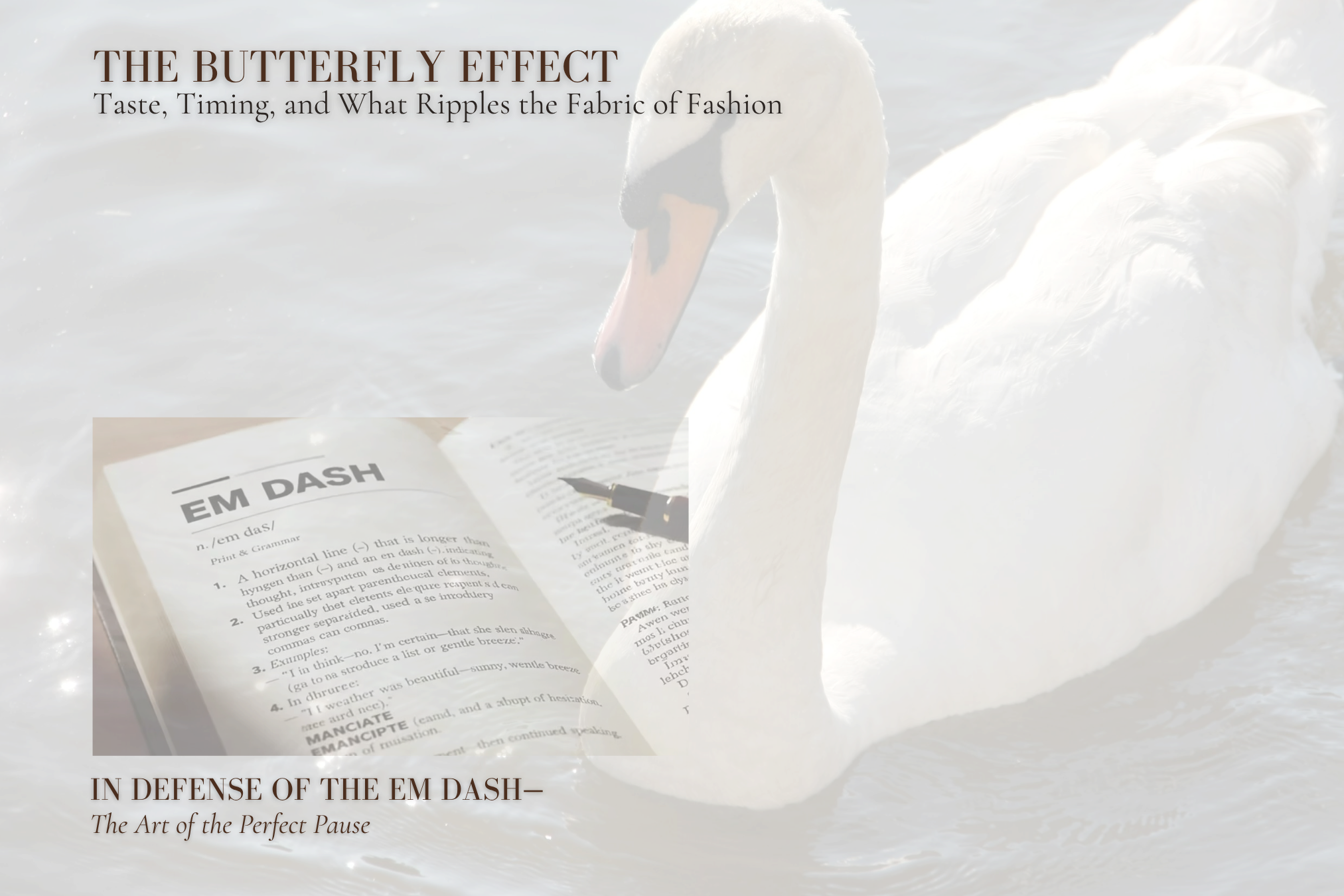
In Defense of the Em Dash—
Who would’ve thought that punctuation would be the next candidate for cancel culture? Oh, but indeed it is…
On the chopping block—the em dash. Do you see what I did there?
Heralded as the loose-lipped punc, she’s become infamous as AI’s shameful lover—the giveaway girl, if you will. A piece marked by em dashes? AI-written.
But me—I’m here to defend her honor. Her purity. Her importance. Punctuation? It wouldn’t be the same without the em dash.
I’ve been a devoted user of em for years—before she was all the rage, or the target of all the rage. She’s a beautiful little slice of punctuation. Elegant. Elongated. She gives you pause—literally.
As the daughter of an AP high school English teacher and a law professor, I fell naturally into my obsession with grammar. Diagramming sentences? I loved it. Nouns. Verbs. Adjectives. Adverbs. A gerund here and there? Come one. Come all. I love them equally. Truth be told, I’ve used grammar to narrow down the dating pool. If he can’t differentiate between there, their, and they’re or two, to, and too? Swipe left.
But punctuation? That’s where the fun really begins. Punctuation is voice. It changes the meaning of what you’re writing. It controls the cadence. A comma? Magnificent. It slows you down. A slight pause. An exclamation mark? The choice of drama kings and queens everywhere. Emphasis. Attention. Too many? You’re in Comic Sans territory. Don’t overuse and abuse the exclamation point!!! See my point—or points, as the case may be?
But the em dash? She’s a rare beauty. Unlike a comma, she’s a dramatic pause. A pivot. A break in an idea. She allows the reader a chance to pause, to absorb or redirect, and move on to the next idea. She lends clarity to a sentence. She emphasizes, breaking free from the comma quagmire. She’s a regular chameleon.
And just look at her. Unlike her cousin, the hyphen—short, stocky, unexceptional—she’s elegant, long, beautiful. The neck of a swan. The straight line of a column (inverted, of course). And I love her unabashedly.
She’s style. The difference between a serif and a generic sans serif. She’s the unexpected shoe—Matthieu Blazy’s toe-less gladiator. The sculptural closure selected over an ordinary button. The perfect cut lapel. The exaggerated cuff instead of the ordinary sleeve. She’s the one strange flourish—the sprinkle on top, if you will—that makes something unmistakably yours.
Yet somehow she’s found herself on the chopping block. Overused by AI, cancel culture is anointing em with the scarlet letter A. Writing that features em dashes? Obviously written by AI, they trumpet. But I’m here to say—that’s not always the case. Sometimes, em is just stylish. Preening. Swanning.
Why are we suddenly suspicious of recognizable style simply because AI has learned to imitate it? Writers used em first. Emily Dickinson loved her—scattering dashes through her poetry with abandon—long before anyone could accuse her of consulting ChatGPT. Her dashes were part of her voice: pauses, interruptions, suspensions of thought. Imagine editing them out because they’d become unfashionable. Blasphemy.
Me? I’m here in defense of the em dash. If you see her in my writing, know she’s there intentionally. She’s there for voice. For cadence. For control.
Technology? Yes, I use it. Not to write for me—which it would happily do if I let it—but to look over my writing. It’s my editor. As a high school journalist and a journalism major (for approximately five minutes), I always had an editor look over my work. Now, I have AI. I have it look for grammatical mistakes, redundancies, and spelling issues (always the bane of my existence). And ironically, it tries to remove all of my em dashes these days. It must have gotten the memo. The em dash is out.
But I’m pushing back. Much like Blazy’s toe-less gladiators (and god help me, I want them), my em dashes are digging their heels in. They’re here to stay.
Take that—
