The Butterfly Effect | Issue 14 Less 01
Game On
As the Olympics descend upon Milan—a city synonymous with fashion—it’s no surprise that the athletes aren’t the only ones stepping into the spotlight. Fashion, too, has taken its place on the podium.
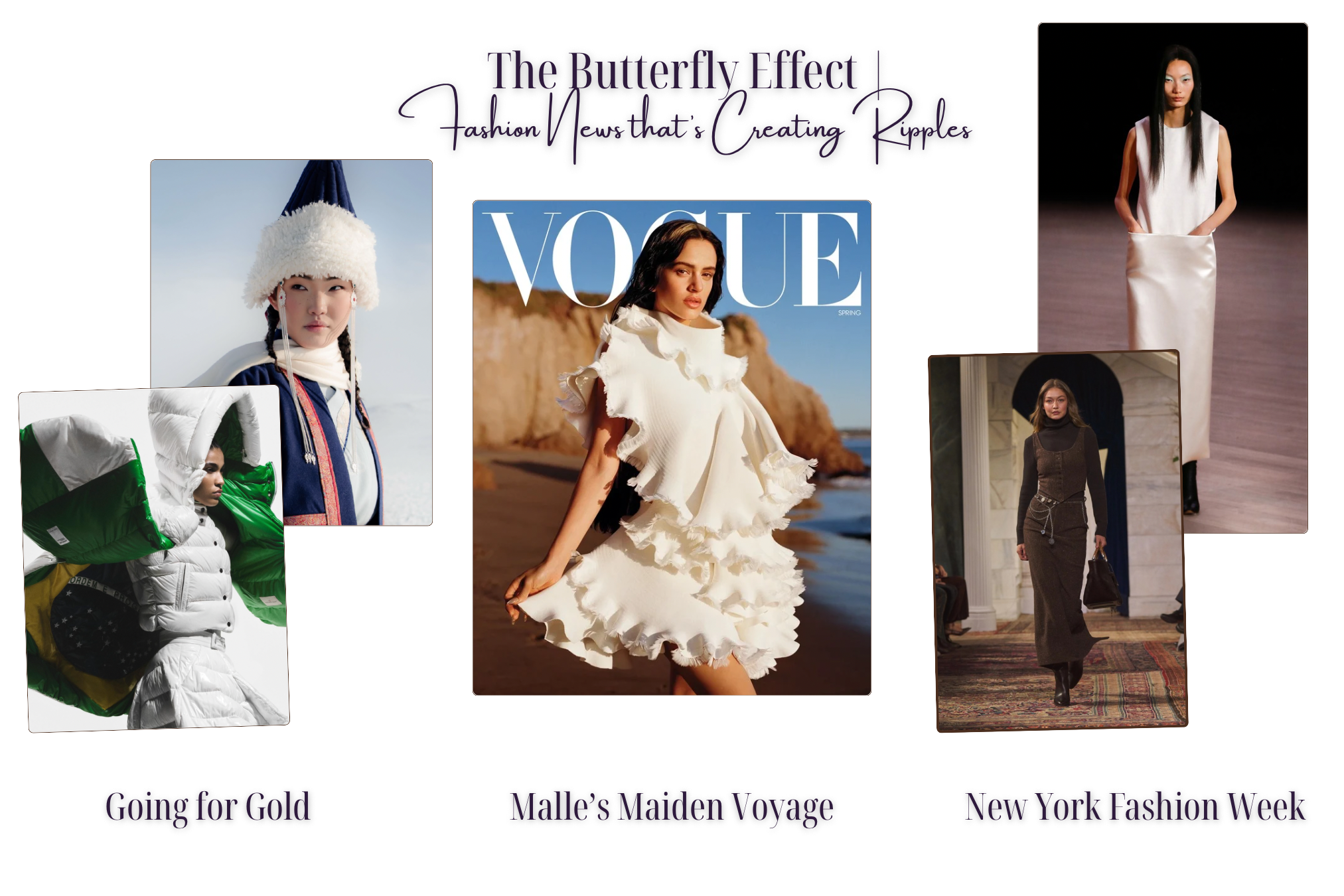
Among the most striking moments was Goyol Cashmere for Team Mongolia. Crafted from the country’s finest Mongolian cashmere and silk, the collection reintroduced elements of ancient Mongolian dress, bringing them thoughtfully into a contemporary fashion context. With the tagline “What We Carried Through Winter, We Carry to the World,” Goyol did exactly that—honoring heritage while presenting it to a global audience. The world, unsurprisingly, took notice.
Equally memorable were Team Haiti’s hand-painted opening ceremony uniforms, designed by Italian-Haitian designer Stella Jean. The looks featured a red, riderless horse set against a lush green landscape and cerulean sky—imagery inspired by the work of Haitian painter and sculptor Édouard Duval-Carrié. The result was both celebratory and symbolic, blending artistry, identity, and national pride.
One of the most unexpected collaborations to grace the San Siro Stadium was Moncler x Brazil. Moncler delivered a sleek, winter-forward ensemble rendered in the colors of Brazil’s flag—green, yellow, blue, and white. “Pure exhilaration,” the brand noted, and the sentiment felt apt: athleticism translated through alpine precision.
Not to be outdone, Team USA took to the floor in looks by Ralph Lauren, J.Crew, and SKIMS. Athletes wore winter-white wool coats finished with wooden toggles, layered over crisp red, white, and blue flag sweaters—a familiar American visual language rendered with ceremony-ready polish.
France—she’s not a maison de couture without raison d’être.Le Coq Sportif’s uniforms spoke in hushed, confident tones, kissed with ivory and powder blue—heritage-forward, thoughtfully restrained, and impeccably French, bien sûr. In a gentle bow to legacy à la Dior and Chanel’s recent collections, while others chased spectacle, Le Coq leaned into lineage, reminding us that elegance, when done right, never needs to shout—and takes the gold every single time.
At the intersection of sport, culture, and craft, the message was clear: the Games may be about performance, but style remains a powerful form of representation.
The Magic of Malle
She had me right out of the gate.
From start to finish, Chloe Malle’s maiden Vogue voyage sparkled. Opening with a Magic School Bus reference—an old favorite from my fourth-grade teacher days—Malle kept her editor’s letter grounded and relatable, weaving nostalgia, delight, and curiosity throughout. More importantly, she positioned Vogue as future-forward, likening her role to that of the sixteen new creative directors presenting their first collections at storied fashion houses, and quoting Jonathan Anderson:
“How do you find newness within something which is already old? By having it dialogue with what’s happening today.”
In an age when print media is rapidly declining, Malle breathed new life into the magazine, reframing Vogue’s purpose and recommitting it to what it does best.
She’s off to a confident start, with a resplendent Rosalía in Dior Haute Couture gracing the spring cover. Bright, distilled, and unmistakably fashion-forward, the image feels like a quiet declaration rather than a shout.
Malle—who, in a winning act of procrastination, absconded to Bergdorf Goodman before writing her column—noted:
“The only thing I ended up leaving Bergdorf’s with, by the way, was a smile. And I hope when people read, watch, and listen to Vogue, they will do the same.”
Here at CbC?
Mission achieved, Vogue.
New York Fashion Week
Marc Jacobs opened New York Fashion Week with a meditation on memory and loss. His Fall 2026 collection marked a distinct shift from recent seasons, which leaned into exaggerated silhouettes and theatrical volume. This time, the line was pared back. Models moved through the runway in columnar shapes, a muted palette, and restrained detail—so restrained that even the sequins read as quiet embellishment rather than spectacle.
Jacobs’ only nod to past exaggeration appeared in loose waistbands, which allowed models to use them as pseudo pockets—a subtle wink rather than a full return to fantasy.
The collection felt reminiscent of Paris’ renewed focus on craft and code, yet Jacobs’ interpretation was decidedly more somber. Perhaps a reflection of current events. The result was a collection both wearable and polarizing.
Jacobs addressed his critics directly on Instagram, quoting Theodore Roosevelt’s “Man in the Arena”:
“It is not the critic who counts… credit belongs to the man who is actually in the arena…”
And Jacobs?
He is very much in the arena.
Heritage House
Gigi Hadid opened Ralph Lauren, setting the tone for a collection rooted in heritage. Like Jacobs, Lauren offered a study in memory—but it read markedly differently, and decidedly less somber.
Composed of country-to-manor looks, Lauren painted the runway in every color of the crayon box—every shade of brown, that is. In a sea of chocolate, texture emerged as the true star. Rich velvets, woven tweeds, crushed silks, fuzzy shearling, supple leather, and crisp suiting brought dimension to layers of mocha, broken only by subtle hits of loden green, silver, animal print, the occasional flash of white, and one solitary floral sweater.
This was heritage without heaviness—each piece effortlessly wearable, yet still breathtaking.
How very Ralph.
Marvelous, Of Kors
And Michael Kors? Resplendent—one look after another. Monochrome executed with discipline and ease. Silhouettes forgiving—slouching just enough—yet cinched and ruched with meticulous intent to honor the feminine form. There was architecture in the drape, precision in the restraint. Perhaps Kors borrowed a page from Dior’s 1947 New Look, leaning into the pillars of construction and structure.
Kors’ collection shared certain parallels with Jacobs’ in its emphasis on wearable, everyday American dressing. Yet where Jacobs veered toward austerity, Kors radiated warmth. Models were washed in vibrant reds, glazed in lacquered caramel, and wrapped in pristine ivory knits. Clothes so saturated and polished, you almost want to take a bite.
Fashion From Coast to Coast
All in all, New York Fashion Week delivered. Though there were certainly a few misses, the collections were strong, cohesive, and unmistakably on brand. And while each house spoke in its own dialect, patterns emerged, offering insight into what we’ll be wearing come September.
Designers painted in black, white, and red once again. Brown—in all her shades—remained a constant. Silhouettes, for the most part, were pared back and tailored, emphasizing and often cinching at the waist. Exaggeration was present, but softened—focused primarily at the shoulder and sleeve.
Animal print, polka dots, and fringe made confident returns.
And though these themes have circulated for several seasons, designers found a way to make them feel new. In the crisp execution of color. In the movement and breath of trim. In the renewed focus on construction. While certain silhouettes—like those at Jacquemus—nodded to the 1940s and 1950s, the rendering felt distinctly 21st century.
In a week in which the news cycle felt wrought and heavy, fashion offered a much-needed reprieve—doing what it does best: opening a window into beauty, strength, and heritage. Because when the world feels unsteady, elegance becomes its own act of courage. So open that window wide.