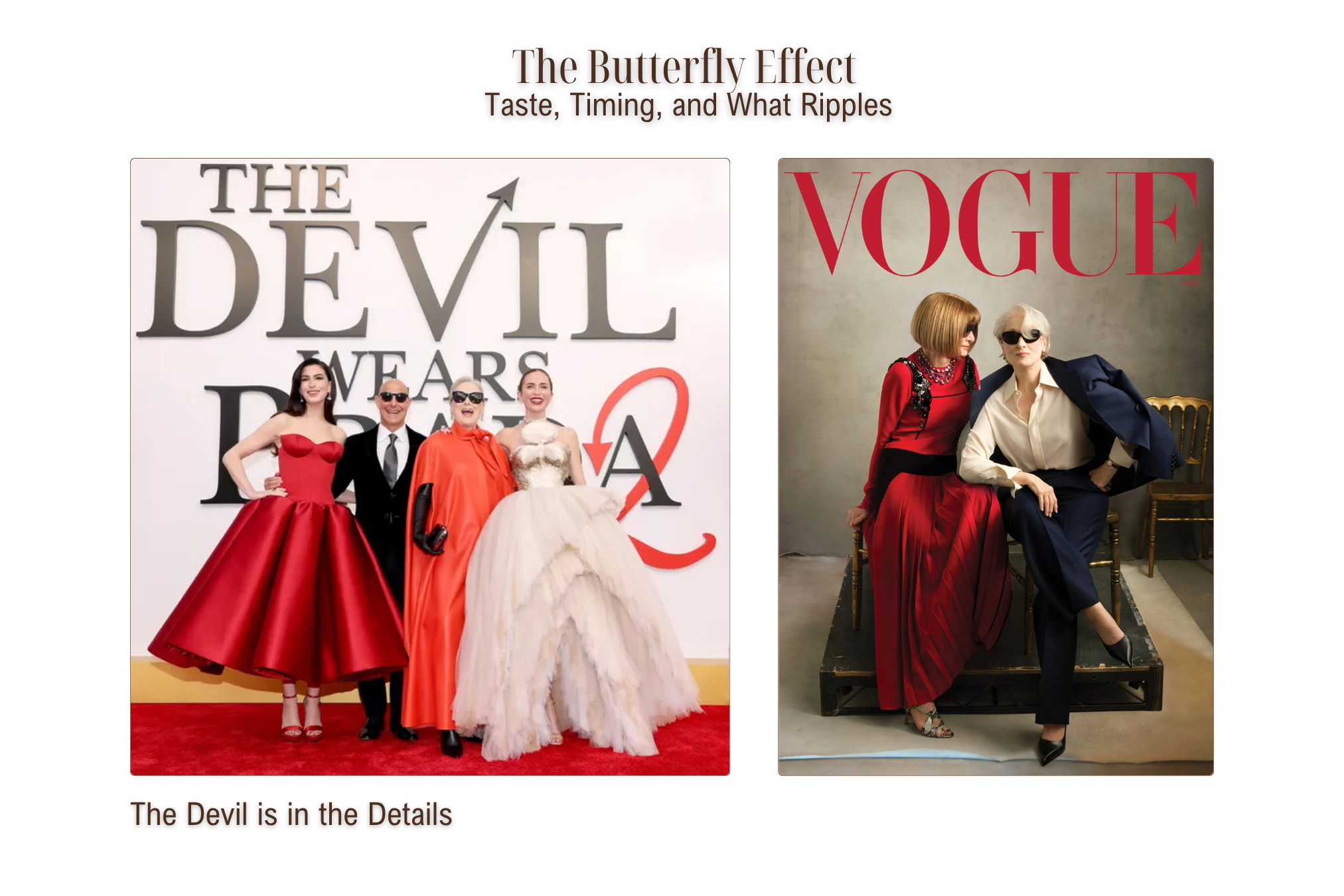
The Butterfly Effect, The Devil Wears Prada
In a world transitioning to kitten heels and ballet flats, it’s no secret that luxury fashion is struggling to find its footing. In a post-Covid economy, people are getting dressed again—but not necessarily in luxury. As prices rise—a pair of Chanel shoes once hovering around $1,000 now closer to $1,500—demand hasn’t followed.
An expanded online marketplace, emerging brands, and a surge in vintage have given consumers more choice—and they’re using it. Overall, luxury is feeling the squeeze, with first-quarter earnings reflecting the shift—even Kering is quietly restructuring.
Yet, in the midst of the turmoil, there is a loosening of the stays and a restructuring of a once untouchable industry. Matthieu Blazy at Chanel and Jonathan Anderson at Dior have infused the industry with a sense of joy—and consumers are responding.
Even the crème de la crème are stepping down from their ivory towers—swapping their stilettos for flats and joining the mere mortals on high street. And in that shift, luxury no longer defines taste—it responds to it.
Case in point: Gap’s collaboration with Victoria Beckham—high street meets high fashion. Anna Wintour on the cover of Vogue. The Bezos-backed Met Gala. At Vogue, Wintour and company have embraced The Devil Wears Prada, featuring Meryl Streep on their current cover and stepping onto the red carpet alongside it.
What reads as nostalgia is something else entirely—a reframing of fashion’s past as part of its present.
The golden gods have fallen from Mount Olympus.
And something once locked in an ivory tower is suddenly within reach.