The Butterfly Effect | Issue 11
Couture—I must confess, prior to listening to Jonathan Anderson’s interview on The Business of Fashion podcast, in which he shed light on the importance of couture, I just didn’t get it. Much like Anderson himself admitted before joining Dior, couture felt distant—beautiful, yes, but also unattainable, overdone, and a bit fanciful.
I watched Dior live on Instagram. I saw Schiaparelli.
My take? Pretty—but overwrought, unreal.
And then I paused and listened to Anderson.
And he completely changed my mind.
One hundred and eighty degrees.
The power of education.
Anderson shone a spotlight on craft. He painted a story of fantasy grounded in skill, and as I listened, the collections metamorphosed before me. Couture transformed from something theatrical and unreachable into something intentional and immersive.
Haute couture is the pinnacle—existing on a different plane, following its own rules. As Anderson pointed out, there is no “no” in couture. Everything can be done. But not merely done—executed at the highest levels, by hand. A dying art, and a throughline Anderson showcased with conviction.
Dior’s pieces? Breathtaking. The construction. The form. Many were modeled from Anderson’s vision of shaping a piece of clay.
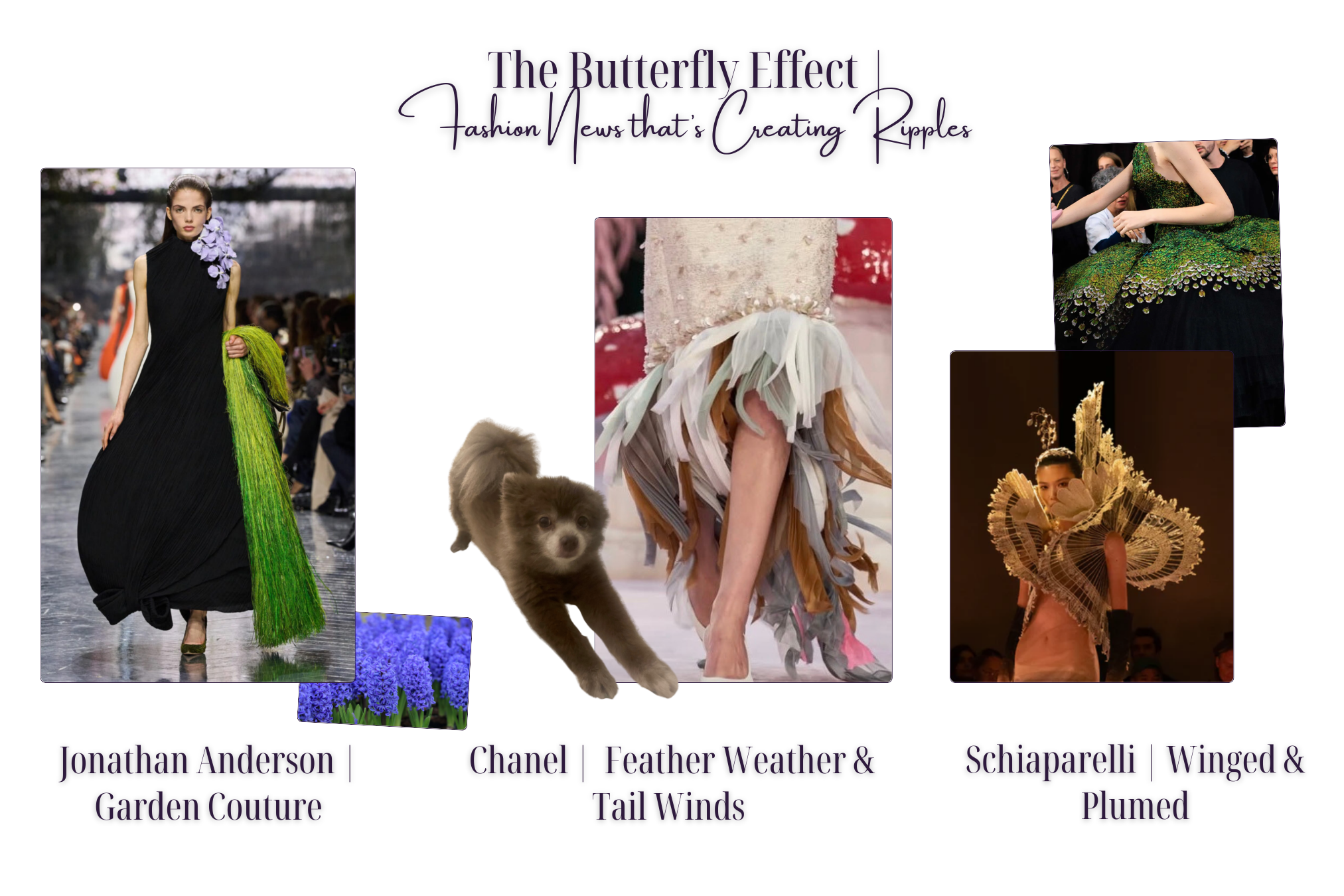
For me, Dior’s skirts and dresses conjured childhood visions of well-loved papier-mâché art projects—pop the balloon, and the form magically remains without its scaffolding. Models wove through an enchanted garden: flowers abundant, flocking the ceiling, bouncing from their ears like fanciful buns, hitching rides on shoulders.
At Daniel Roseberry’s Schiaparelli, visions of exotic birds and reptiles emerged—references to the Sistine Chapel rendered in stiff lace that took on a life of its own. Erect frills that could have graced the shoulders of Renaissance-era paintings.
In contrast, Matthieu Blazy’s Chanel was one of magnificent, fanciful restraint. Models floated beneath oversized mushrooms. His clothes—wearable pieces of art—breathed and moved, fringe once again on display. Bouclé, sheer organza, and pleated, embroidered, and frayed silk “feathers” abounded, echoing his much-lauded New York subway show. Blazy reintroduced the concept of couture as daywear—revolutionary to some, yet deeply rooted in the history of the house and of couture itself.
And at Valentino, Alessandro Michele presented his second couture collection, Specula Mundi—with guests viewing the looks through small square windows and models posed within round pods, evoking a delightful combination of Love Is Blind (not his intention, no doubt) and the Kaiserpanorama, a 19th-century optical viewing device. The result was magnifique: garments that conjured traditional Japanese kimonos and crowned Roman deities alike, with ruffles, pleating, and construction placed unmistakably at the fore.
And couture, this season?
It moved me.
Not in the run-out-and-buy-a-piece kind of way—I wish.
But after seeing Dior, while grocery shopping, I found myself in the floral department, selecting a purple-drenched hyacinth. While it wasn’t a wild cyclamen, it was beautiful and intoxicating all the same. She is my little piece of Dior—and she makes me smile every time I catch her scent.
After seeing Chanel, walking my Pomeranian, Wolfie, back into the much-needed warmth of home (it’s been subzero here in Chicago), I noticed the curl and plume of his tail—reminiscent of the feathers kissing the hemline of one of my favorite Chanel looks. I laughed out loud. What would Blazy say if I told him the hem of his couture gown conjured Pomeranian fluff?
But that?
That is the power—and the joy—of couture: the ability to make you feel, to imbue awe.
Long live the kings of couture—Anderson, Roseberry, Blazy, Michele.
May we bow at your handcrafted hemlines for many years to come.