The Butterfly Effect 42—
NYFW SS27, Part II
Keeping the Fantasy Alive: From the Kitchen to the Hive and Beyond
NYFW SS27 continued this week before wrapping on Tuesday. And what started with an explosion of color, texture, silhouette, and fringe à la Tory Burch, Ralph Lauren, and Kallmeyer—to name drop a few—ended on just as strong of an exclamation point.
Magda Butrym, Altuzarra, Carolina Herrera, and Thom Browne didn’t disappoint.
Magda Butrym riffed her collection on the memory of her grandmother’s apron—and oh what an apron it must have been. Ironically Nara Smith, who recently vehemently denied being a trad wife on Alex Cooper’s Call Her Daddy podcast—methinks she doth protest too much—sat front row.
Much like the aforementioned apron, the collection cooked. The apron riff was modern, flirty, and feminine, marrying diaphanous fabric and waist-defining pieces. Butrym also gave a nod to the leather she is famous for and the cinched waist jackets of past seasons, favored by It fashion darlings like Hailey Bieber. The once cropped and belted puffer jackets now spilled past the waist and hit knee-length. For good measure, Butrym also featured more cropped jackets.
Her palette was decidedly neutral—hits of chocolate, chestnut, black, sand, and ivory marked with an occasional sprinkle of soft buttery yellow and dusty rose. A varied collection of outerwear and underwear for outerwear was feminine and flowing, balanced by structured hits of leather and satin.
Overall, Magda Butrym blended up a modern, romantic take on spring, and with aprons like these, even I might be inspired to cook… stranger things.
Carolina Herrera’s runway pulsed with ruffles, fringe, diaphanous layers and a buzzy palette of black, white, and marigold. For good measure, Wes Gordon threw in a smattering of khaki, bright red, pistachio, and a little shot of blue.
The collection? American resort wear at its best. Models sauntered down the runway in form-fitting dresses that cinched at the waist and flared slightly at the hips. Not all of the looks were body-con—sheer organza billowed from models’ waists, floating languidly in their wake.
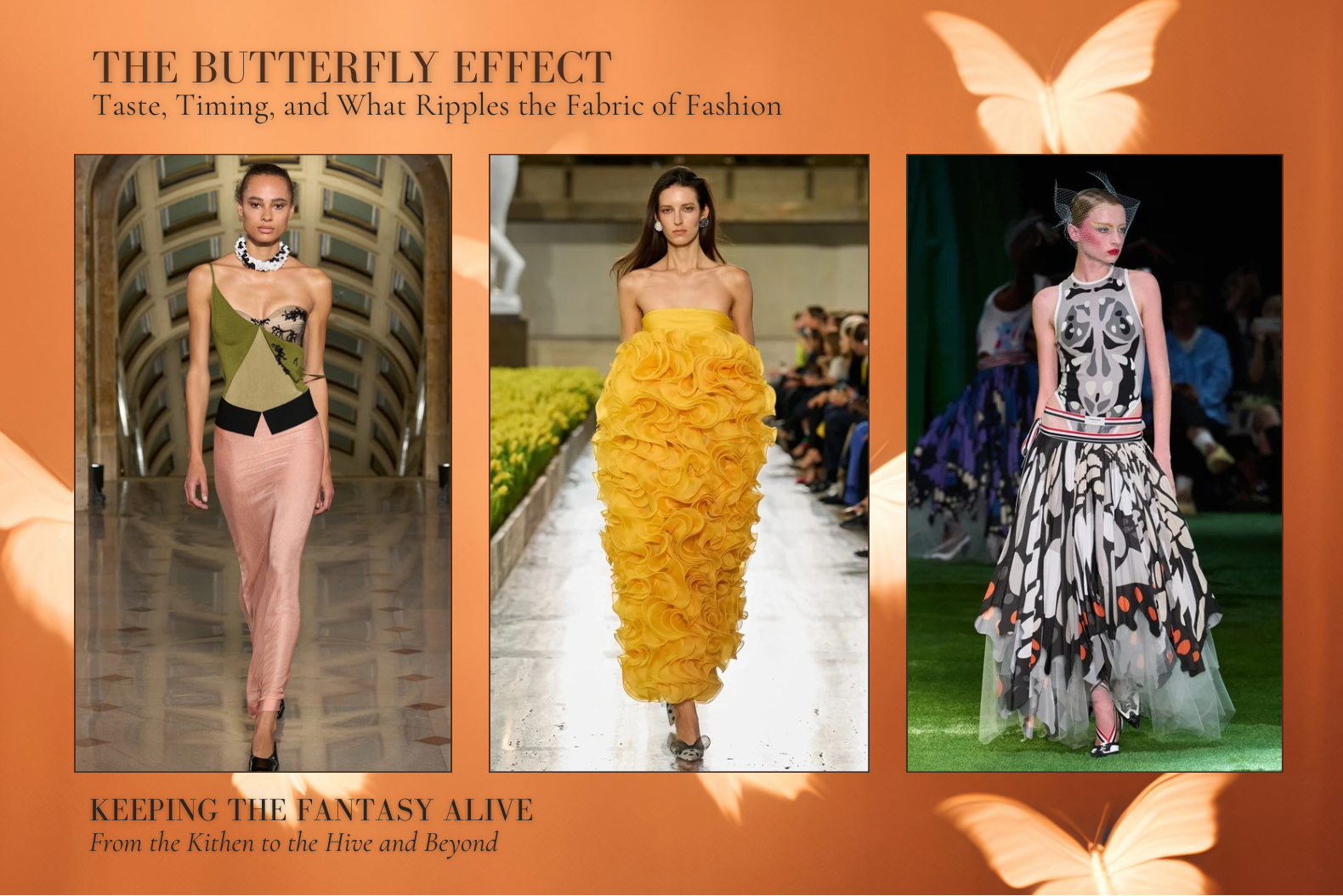
Ruffles were the order of the day—around necklines, piled up at the waist, dancing around the wrist, playfully flicking back and forth above the ankles, and, in some cases, as in Look 59, claiming their territory completely from just below the bust to the floor—my favorite look, by far.
If Herrera’s runway was a color-coded ode to the bumble bee, then Thom Browne wove the entire insect anthology on his catwalk—and I (not normally a Browne fan) absolutely fn loved it. The runway started quite staid—staid that is for Browne—with a subtle palette of grey mixed with hits of pastel yellow, pink, and blue. The insect references began subtly, as well. An embroidered bee hiding behind a lapel. A straw boater with a brightly colored net gathered at the top—the hat for the modern, albeit fashionable, beekeeper.
But by Look 10? Embroidered dragonflies swarmed jackets, embellished greenery trailed across lapels and shoulders, and rhinestone beetles and butterflies alighted on green-checked coats. But Browne didn’t stop there—far from it. Look 29? Arresting—an entire ladybug—the shiny, candy-coated red body forming the balloon-shaped skirt; her head and eyes the bodice.
Could Browne have left it there? He could have, but then he wouldn’t be Thom Browne, would he? For Looks 54-62, Browne illustrated the complete metamorphosis of a butterfly—and at The Butterfly Effect, we’re obsessed—complete from caterpillar, to cocoon, to emergence, and ultimately, in the final look, to butterfly.
And Look 62, the final piece, was the crowning jewel of the collection—a butterfly composed of layers of sheer fabric representing her wings swirling around the model’s ankles. And Browne? Like the monarch he is, he spread his wings wide and flew high, keeping the fantasy aloft.
And though they might not have compared show notes, Joseph Altuzarra’s runway was built on a similar theme. “What was once hidden becomes visible; glamour comes from within,” he wrote in his show notes. Much like Browne’s actual butterfly, Altuzarra, too, captured the magic of metamorphosis.
And while he didn’t use a literal butterfly, Altuzarra peeled back the layers of dress, much like Khaite did earlier in the week. Just a glimpse of underpinnings flashed as the models floated down the runway, highlighting structure beneath beauty. Here a flash of bra. There a bit of lace or a crinoline. Bra straps sliding purposely down models’ arms—who among us doesn’t know that feeling? Here was real life—but make it beautiful. Make it embellished, or beaded, or satin.
And the glamour that he called out? Altuzarra had it in spades. Swinging midi skirts—many in bright printed taffeta—swirled at the models’ hips. Metallic tiger stripes were cinched at the waist with leather-like cummerbunds—a look I’ll be stealing from spring’s runways. Beautiful sheer floral-print dresses swirled into handkerchief bottoms that kissed the floor. The overall effect—the epitome of glamour.
This season, New York brought back the joy. Fashion was fantasy once again—magical, transformative. But the fantasy, strangely enough, wasn’t an escape from reality. Instead designers transformed ordinary, familiar items—an apron, an insect, underwear, the internal construction of a garment. They made them strange and beautiful again.
And in a world often bogged down by technology, Artificial Intelligence, doomsday forecasting, and strife, perhaps, a return to the ordinary—the familiar, the tangible, the human things—is what we all crave. And if that return is laced with feathers and embroidery and a little bit of netting on a boater hat? Well, even fn better.